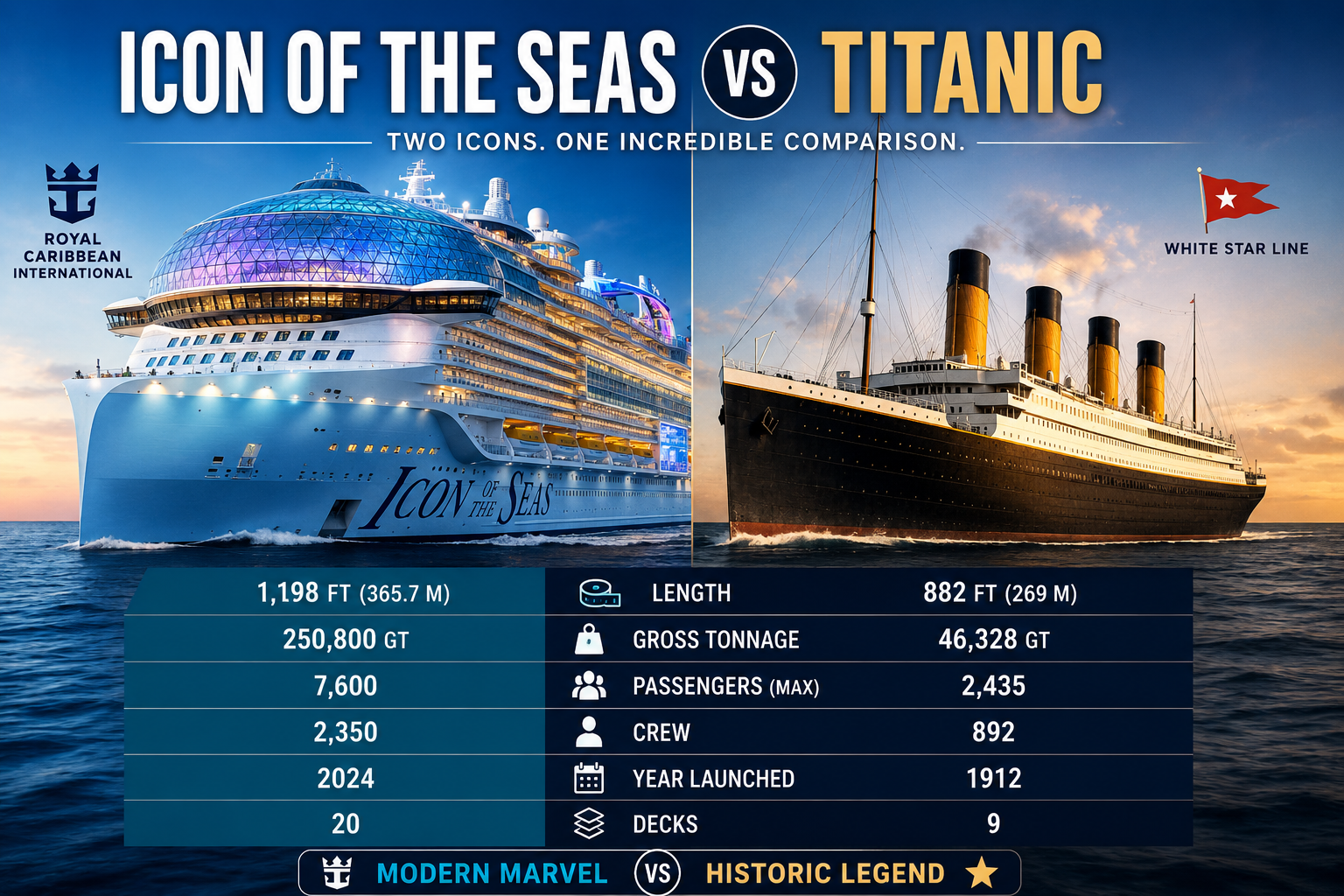
Icon of the Seas Compared to Titanic: How the World’s Largest Cruise Ship Stacks Up Against a Legendary Ocean Liner
The comparison between Icon of the Seas and the Titanic has become one of the most fascinating topics in modern maritime discussions. Whenever a new record-breaking ship enters service, people naturally compare it to the Titanic, perhaps the most famous ship ever built. Although more than a century separates these two vessels, they represent important milestones in the history of shipbuilding and ocean travel.
The Titanic was considered a marvel of engineering when it launched in 1912. It symbolized luxury, innovation, and the ambition of an era that believed technology could overcome nearly any challenge. More than one hundred years later, Icon of the Seas Compared to Titanic has captured global attention for similar reasons. As the largest cruise ship ever built, it showcases just how far maritime engineering has advanced.
Despite these similarities, the two ships are fundamentally different. The Titanic was designed primarily as a transatlantic ocean liner carrying passengers between continents, while Icon of the Seas Compared to Titanic is a floating vacation destination built for entertainment, leisure, and family travel. Understanding these differences provides valuable insight into how passenger ships have evolved over the past century.
The Historical Significance of Titanic
When Titanic entered service in 1912, it was among the largest and most luxurious ships in the world. Built by the White Star Line, the vessel represented the pinnacle of early twentieth-century engineering and design. Wealthy passengers enjoyed amenities that were unmatched at the time, while immigrants viewed the ship as a gateway to new opportunities in America.
The Titanic measured approximately 882 feet in length and weighed around 46,000 gross tons. These dimensions were considered enormous for its era. The ship featured grand staircases, luxurious dining rooms, elegant cabins, and advanced technological systems that impressed passengers and industry experts alike.
Unfortunately, Titanic’s story became one of history’s most famous maritime tragedies. After striking an iceberg during its maiden voyage, the ship sank in the North Atlantic Ocean, resulting in the loss of more than 1,500 lives. The disaster permanently changed maritime safety regulations and remains a powerful reminder of the importance of preparedness and safety at sea.
Introducing Icon of the Seas Compared to Titanic
More than a century after Titanic’s launch, Icon of the Seas Compared to Titanic has redefined what is possible in modern shipbuilding. Operated by Royal Caribbean International, the ship officially entered service as the largest cruise vessel ever constructed.
Unlike Titanic, which focused on transporting passengers across the Atlantic, Icon of the Seas Compared to Titanic is designed primarily as a vacation experience. The ship functions almost like a floating city, offering entertainment venues, water parks, restaurants, shopping areas, theaters, pools, and countless recreational activities.
The vessel represents decades of technological advancement. Engineers incorporated modern safety systems, environmental technologies, and hospitality innovations that would have seemed unimaginable during Titanic’s era. As a result, Icon of the Seas Compared to Titanic stands as a symbol of how dramatically the cruise industry has evolved.
Size Comparison: Icon of the Seas Compared to Titanic
One of the most striking differences between the two ships is their size. While Titanic was considered enormous in 1912, Icon of the Seas Compared to Titanic makes it appear relatively small by modern standards.
Titanic stretched approximately 882 feet from bow to stern. In comparison, Icon of the Seas Compared to Titanic measures nearly 1,200 feet in length. This means the modern cruise ship is more than 300 feet longer than the legendary ocean liner.
The difference becomes even more dramatic when examining gross tonnage. Titanic weighed about 46,000 gross tons, whereas Icon of the Seas Compared to Titanic exceeds 248,000 gross tons. In simple terms, the modern vessel is more than five times larger than Titanic in terms of internal volume and capacity.
Visual comparisons often surprise people because Titanic’s reputation as a giant ship remains deeply embedded in popular culture. However, modern engineering has enabled shipbuilders to create vessels on a scale that early twentieth-century designers could scarcely imagine.
Passenger Capacity and Accommodation
Passenger capacity is another area where the differences are remarkable. Titanic could carry approximately 2,400 passengers, along with hundreds of crew members. At the time, this was considered an impressive number.
Icon of the Seas Compared to Titanic can accommodate more than 5,600 guests under normal operating conditions, with total capacity exceeding 7,000 passengers and crew combined. This makes it one of the most populated passenger vessels ever constructed.
The accommodations themselves also reflect changing expectations. Titanic’s first-class suites were luxurious for their time, featuring elegant furnishings and private amenities. However, modern cruise ship accommodations offer a much wider range of options, including family suites, virtual balconies, private terraces, and advanced entertainment systems.
Today’s passengers expect convenience, technology, and personalized experiences. Cruise lines have adapted by creating accommodations that function more like upscale resort rooms than traditional ship cabins.
Entertainment and Onboard Activities
Perhaps the biggest contrast between Titanic and Icon of the Seas Compared to Titanic lies in onboard entertainment. Titanic offered impressive amenities for its era, including libraries, lounges, dining rooms, a gymnasium, and social gathering spaces.
Icon of the Seas Compared to Titanic operates on an entirely different level. The ship features multiple neighborhoods, water slides, surf simulators, theaters, pools, adventure attractions, live performances, and countless dining options. Guests can spend an entire week onboard without experiencing everything available.
The modern cruise industry focuses heavily on entertainment because today’s travelers seek immersive vacation experiences. Cruise ships are no longer simply transportation vessels; they are destinations in their own right.
Families, couples, and groups can all find activities tailored to their interests. This variety helps explain why modern cruise ships continue growing larger and more sophisticated.
Safety Innovations: A Century of Progress
The Titanic disaster had a profound impact on maritime safety regulations worldwide. One of the most significant lessons involved lifeboat capacity. Titanic did not carry enough lifeboats for everyone onboard, a factor that contributed to the tragic loss of life.
Modern cruise ships like Icon of the Seas Compared to Titanic operate under strict international safety standards. The vessel carries sufficient lifeboat capacity for all passengers and crew, along with additional emergency systems and backup measures.
Advanced navigation technology also represents a major improvement. Modern ships use satellite systems, radar, computerized navigation, and real-time weather monitoring to enhance safety. These tools help crews identify hazards and make informed operational decisions.
Fire protection systems, emergency communication networks, evacuation procedures, and crew training programs further strengthen passenger safety. The lessons learned from historical disasters have played an essential role in shaping today’s maritime industry.
Environmental and Technological Advancements
Technology has transformed nearly every aspect of ship design since Titanic’s era. Early twentieth-century vessels relied heavily on coal-fired steam engines, requiring large crews to maintain operations.
Icon of the Seas Compared to Titanic utilizes advanced propulsion systems and incorporates technologies designed to improve fuel efficiency and reduce environmental impact. These innovations reflect the modern industry’s growing emphasis on sustainability.
Digital technology also enhances the guest experience. Mobile applications, smart room controls, digital reservations, and high-speed internet connectivity allow passengers to enjoy conveniences that were unimaginable in 1912.
The ship’s engineering systems are equally impressive. Modern automation helps manage energy usage, water treatment, waste processing, and operational efficiency. These advancements contribute to both environmental performance and passenger comfort.
Why People Continue Comparing These Ships
The fascination with comparing Icon of the Seas Compared to Titanic stems largely from their symbolic significance. Both ships represent the pinnacle of engineering achievement within their respective eras.
Titanic became famous because of its tragic fate and enduring cultural impact. Books, documentaries, and films have kept its story alive for generations, making it a natural reference point whenever a new record-breaking vessel appears.
Icon of the Seas Compared to Titanic captures public attention because it demonstrates how far shipbuilding technology has progressed. Comparing it to Titanic helps people visualize the extraordinary advancements that have occurred over the past century.
These comparisons also reflect humanity’s ongoing fascination with innovation. People enjoy measuring modern achievements against historical milestones to better understand technological progress.
The Future of Cruise Ships
If history has shown anything, it is that shipbuilding continues to evolve. Just as Titanic once represented the height of maritime engineering, Icon of the Seas Compared to Titanic may eventually be surpassed by even larger and more advanced vessels.
Future cruise ships are likely to emphasize sustainability, energy efficiency, and enhanced guest experiences. Emerging technologies could further transform onboard entertainment, navigation systems, and environmental performance.
The industry continues investing in research and development to meet changing traveler expectations while addressing environmental challenges. As a result, the next generation of ships may look very different from today’s vessels.
What remains constant is humanity’s desire to explore, travel, and innovate. Ships have always reflected the ambitions of their era, and future designs will undoubtedly continue that tradition.
Conclusion
The comparison between Icon of the Seas Compared to Titanic highlights more than just differences in size. It tells the story of over a century of technological progress, changing travel preferences, and advancements in safety and engineering.
Titanic was a groundbreaking achievement for its time and remains one of the most famous ships in history. Its legacy continues to influence maritime practices and captivate public imagination. Meanwhile, Icon of the Seas Compared to Titanic showcases what modern engineering can accomplish, offering a scale, level of comfort, and range of experiences that would have seemed impossible in 1912.
While Titanic will always hold a unique place in history, Icon of the Seas Compared to Titanic demonstrates how far the maritime industry has come. Together, these two ships serve as powerful reminders of humanity’s ongoing pursuit of innovation, exploration, and excellence on the world’s oceans.
You May Also Read: Blue Jays vs Dodgers